Monday, September 5, 2011

Summer Updates

So, I haven't updated since March. In that time many JETs have gone home, and new arrivals have settled in. Japan has also been the focus of attention internationally due to the ongoing Fukushima nuclear reactor shutdown crisis. At least one reader of my blog assumed that I had left the country.

Well, I'm still here! Part of the reason for the lack of updates is that I have been busy - the new school year started in April, and I took a trip back to the States in June. Another element is that I sometimes feel I've run out of things to write about. When I first arrived in Japan, everything was new and exciting and I knew (or at least hoped) that people reading my blog from back home would want to hear about my amazing adventures. Lately, though, the things I've been doing have been mostly rehashes. Nobody wants to read sixteen consecutive updates about snowboarding. I'm still having a great time here, but things have settled down into a sort of normalcy that I personally don't find very interesting to write about, and I assume that people wouldn't find very interesting to read about.

I'll try to keep up on occasional updates from here on out - I am still doing things, and taking pictures, and having ~wacky Japan adventures~. So in that vein, here's an updates!

New JET arrivals show up at the end of July and beginning of August. Around the end of August and beginning and of September are a series of welcome parties around the island of Hokkaido, which are generally planned as camping trips.

Two weeks ago I traveled six hours southwest to attend one of the these parties, along with several other ALTs. Normally I wouldn't have traveled that far for a party like this - if I want to sit in the woods and drink I can do that a few hundred meters from my apartment. In this case, however, the festival coincided with the famous Noboribetsu Hell Festival (Noboribetsu is the name of the town).


It's pretty much all about these guys, which are ogres or demons or whatever and are fond of stealing human women and drinking. Especially drinking. As a side note, early Japanese depictions of Westerners look pretty much exactly like these guys.


Noboribetsu is situated on active volcanic ground, which means it has steam vents everywhere and smells like sulfur. For this reason, is it considered to be a top location for hotspring resorts. This smoky ambiance provides the setting for the Hell Festival.

The main event of the festival is the carrying of Mikoshi, large figures of demons, down the street. They look something like this:


And once night falls, they are carried down the street by large gangs of drunk Japanese people, who look like this:


Sometime foreigners also get involved!


Here's a bonus from our time exploring the town before the festival.


Good times.

Monday, March 28, 2011

Mo' Boardin

When I initially heard that I would be heading to Hokkaido, I decided that it would be pretty silly to waste the opportunity and not learn how to snowboard. This was despite the fact that I had never done it or anything similar before, and despite the fact that I am rather uncoordinated.

Almost three months after my start, the season is now nearing its end and I finally have some decent pictures to show for it. On Sunday we drove out to Kurodake, a mountain in the middle of nowhere and still snow-covered. Since I have a new camera, I documented the experience here for the enjoyment of all!


We headed out in the morning in high spirits, despite it being 7:30 AM. Full of dreams of snow, energy drinks, and beer, we made the roughly two-hour drive into the mountains.


We rode a large ropeway gondola up the mountain, which I didn't get any good pictures of. The ski course at Kurodake is fairly short, but its almost all the way up the mountain - good snow and good views abound.


This is the view from the top of the ropeway - there's still a short walk and a chairlift to ride to the top of the snowboard area.


Here's the view of the mountain peak from the chairlift. One of our party hiked the whole way up. Myself and another guy tried to do it carrying our snowboards, and made it about 200 meters before giving up. As you can see, however, we had a beautiful day for the attempt.


Later on the weather turned worse, but still tolerable. No night skiing at this mountain, however, so we headed out at 3 for ramen, hot springs, and the drive home.

Tuesday, March 22, 2011

Graduation Day

Have you always wondered what it looks like when a bunch of Japanese 12 year olds graduate from their elementary school and move on to bigger and better things, like junior high? If so, you've come to the right place!

In Japan, the school year starts in April and ends in March. As it is now March, you may have deduced that the school year has just ended. All of my schools thus had graduation ceremonies, ranging from six students to over seventy at the largest schools. Like in American schools, these kids are all 6th year students who are now entering junior high school. All of my graduation events took place at the same time, so I was unfortunately only able to attend one of them; I would have liked to see all of my students graduate, but it was not to be.


The school that I went to was the smallest of my "big" schools, with around 60 students in grades 1 through 6. This school had 11 graduating students. In the morning, all of the non-graduating students assembled in the gym, with the stage all made up for the ceremony. Behind them were stools for the parents and relatives of the graduating students, who hadn't arrived yet. The banner on stage says "Congratulations on Graduation".


The teacher of the 6th year students came in, followed by the graduates, one by one. They walked through the audience to the front of the gym.


Here you can see some of the 6th years at the front. In Japanese elementary schools, students don't wear uniforms; in junior high and high school, they do. The graduating students here are wearing their new uniforms - black suits for the boys and blue skirts and blazers for the girls. These are formal uniforms, for occasions like this and the school entrance ceremony - for day to day class they have school-issued tracksuits. The kids are quite proud of their new uniforms.

Speeches are given and diplomas handed out. After receiving their diplomas, each student says some words of thanks to their family and teachers - one of the advantages of a smaller school. After all have been handed out, the graduating class and the rest of the school sang a few songs.

After the ceremony ended, there were lots of pictures taken, which I'll probably get a hold of later. I did get my picture taken with the teacher of the graduating class:


Some teachers wore traditional ceremonial dress, like this, while others were dressed in western-style suits.

Next week I'll be able to go to the entrance ceremony for one of the middle schools, where I can see some more of my students who's graduations I wasn't able to attend. Until then, I hope you enjoyed this look at an important event in students' lives.

Tuesday, March 15, 2011

What's Shakin'

My apologies for another long wait. As I'm sure anybody reading this is aware, Japan was struck recently with a magnitude 8.9 earthquake off the eastern seaboard, followed by a devastating tsunami. In case anybody reads this that I haven't contacted yet, I am fine; Hokkaido in general was not very strongly affected, and Monbetsu suffered no ill effects at all. Apparently the actual earthquake was vaguely noticeable in town; I didn't notice, as I was busy working on my computer, so that tells you how strong it was. Some towns on the southern coast suffered tsunami waves, but nothing of the level of areas further south. At present, I believe Hokkaido has had a total of one death.

There are a few other things I'd like to say about this disaster. This may sound bad, but bear with me: a disaster of this magnitude could not have picked a better country to happen to than Japan. It is my firm belief that while the damage here is terrible, the cost in human lives and suffering would have been many times worse in any other country.

Japan is a nation well-equipped for disasters. Earthquakes, tsunamis, and volcanic eruptions are not a possibility here, they are an accepted part of life - it's not a matter of if, it's a matter of when. Japan has extensive procedures, infrastructure, and training put in place for the purpose of disaster warning, evacuation, and recovery. All of these factors, I believe, have helped and will continue to help ensure that Japan passes through this challenge with a minimum of suffering.

Additionally, while Japan may be in an economic low point, it is still a wealthy country. Those who have lost everything to the tsunami - and they are many - will have a much greater chance of recovering a semblance of normalcy faster than they might in a poorer country. Japan also has a relatively functional social safety net, so people who have lost everything are not truly as screwed as they might be elsewhere (not pointing any fingers).

Finally, the Western media seems to be focusing a great deal of attention on Japan's so-called "Nuclear Disaster". Because nuclear power generators were threatened by the tsunami, they have become part of the struggle, but there is no chance of a Chernobyl-style meltdown and the loss of power is far more devastating to Japan than any released radiation might be. There are many sources that can explain the technicalities of why the nuclear shutdown is not the disaster that nuclear-phobic sources want it to be; here is one. Please read this and other sources if you are concerned about the nuclear situation.

Life will recover and go on as normal in Japan. This disaster should be a lesson to us all; disasters do happen, and when they do it pays to be prepared.

Monday, January 31, 2011

Enhanced Invigoration

My apologies for the lack of updates! My camera is currently broken, which means my supply of pictures is limited, and a post without pictures is a post without joy. Here's a post about January, however, for your reading pleasure.

For the bulk of January, my schools were on break - this is the break between the second and third trimesters of school, and lasts about a month. Hokkaido is filled with snow, mountains, and cows; during this break I decided to exploit two of these three resources and learn to snowboard (and I could always have a hamburger afterwards),

Snowboarding, like do-it-yourself piercing and teaching English abroad, requires a special kind of idiocy to attempt, a brand of gleeful obliviousness to consequences. It was in this spirit that I traveled with friends to Kamui, a mountain a few hours away. In the grand scheme of things, Kamui isn't that big; to somebody from Minnesota, it's a monster. With a great sense of foreboding, I got on the gondola and ascended into the fog... and ascended... and continued ascending. I estimate when we finally got out, we must have been at approximately the cruising height of a commercial jet, or possibly a weather balloon.

The next step is to grunt and struggle like a beached whale while you attempt to strap your feet to a (borrowed) plank of wood, or fiberglass, or whatever those things are made out of. Then you just flop around until you end up with the board end down, and fall down the hill. Easy!

My first day snowboarding was a disaster. I am told that this is a common experience. Since that day, midway through January, I've been out a little over a dozen times. Monbetsu has a ski hill in town; while it isn't quite on the same sub-orbital level as Kamui, it gets the job down and provides a good place to practice.

Here's me and Adam at the top of our local hill:


You can see the ocean behind us! Here's me a bit farther down, looking about as cool as I ever do:


Beautiful!

Saturday, January 1, 2011

Meari Kurisumasu!

Happy Holidays, Merry Christmas, Happy Hanukkah, and a Krazy Kwanzaa to friends and family around the world. I hope everyone had a good one, and enjoyed New Year as much as I did (I'll write another blog update about New Years later; this one's about Christmas). In this update I'll give a little overview of Christmas in Japan, as well as my own Christmas celebration.
Like many things imported from the West, Christmas in Japan resembles the Christmas most of us know in many ways, but it is unlikely to ever be mistaken for the "original" article. For one thing, opinions here differ as to the actual date of the holiday; many of my students have politely informed me that Christmas is on the 24th of December, rather than the 25th. My theory regarding discrepancy is that, since Christmas day in the West is often largely idle, and many big Christmas events take place on Christmas Eve, many Japanese got the impression that the 24th was the actual holiday. Remember that for many people here, impressions of the West are often based largely based largely on TV and movies, and in any case Christmas here is a fairly minor novelty holiday more akin to something like Valentines Day back home. Nobody expects to get Christmas off of work, for instance.
Back to the holiday itself. Christmas in Japan is first and foremost associated with one person, that patriarch of holiday cheer without whom Christmas could not exist: Colonel Sanders. Yes, nothing says Christmas in Japan like KFC, or "Kentucky" as it is known here. Lining up around the block to enjoy Kentucky is often the main event of Christmas (and is usually done on Christmas Eve, contributing to the confusion about the date). If you weren't aware, KFC is far more popular in Japan than it ever was at home, probably because Popeye's doesn't exist here.
Another indispensable ingredient of Christmas in Japan is, of course, the traditional Christmas Cake. This is a completely normal cake, usually with strawberries, adorned with a Santa figure to signify that it is, in fact, a Christmas cake, and not a birthday or wedding cake. The closest parallel I can draw to this is the unique Western holiday fruitcakes that have been politely gnawed at during family Christmas gatherings since time immemorial.
Santa does exist here, but he climbs into houses through the window and and is pulled by a single reindeer(unnamed, has a red nose). Also, as is fitting for Japan, Santa is a much slimmed-down version of his Western self. Must be all that fish.
As for my own Christmas, I celebrated with a relatively low-key day with friends. In the run-up to Christmas, my plans all fell through and I was in danger of spending the holiday alone in my apartment with a bottle of champagne; probably not something I'd want to blog about. At the 11th hour, however, I was invited to a turkey dinner on the other side of the island, and thus saved from my lonely fate.
After Christmas, I hit the mall before heading home. My mission was to buy keychain figures of Marimokkori:


He's a ball of moss with an erection. He exists because of a bad Japanese pun. He is very popular with children. If I had to choose one thing to represent Japan, I might choose Marimokkori.
We also had dinner in the mall, at an okonomiyaki restaurant. Okonomiyaki is a sort of Japanese pancake or pizza, filled with various toppings and grilled at the table. This night I tried Monjayaki, a variation which was introduced to me via the description, "It looks like cat vomit and foreigners never like it". Of course, it was delicious.

Sunday, December 19, 2010

Decemembered

Here's an update without the usual heart-wrenching pathos, thought-provoking themes, and literary sleight-of-hand that usually characterizes my blog updates. It is, if you can believe it, a collection of mostly-pointless unrelated blurbs. Shocking, right?

Last week I posted about the Sapporo Orientation. I then proceeded to get snowed out of Monbetsu, and had to stay overnight in Asahikawa as the major expressway that runs through the mountains was closed due to blizzard. It looked like this outside:


I actually took this picture because of the political poster, which is my favorite one in the world and features an older Japanese guy leering like he just saw Sailor Moon's panties. You can't really make it out that well in this picture, but it's really the worst-advised political portrait I've ever seen. Regardless, it also serves to show that it was very snowy! Note the person in my side mirror, who will soon try to pass me because I have the audacity to only speed by 10km in a blizzard.

On the plus side, I got to eat some delicious curry.


This particular restaurant, CoCo Curry, allows you to add on spiciness levels to your curry for extra money, up to a spiciness of level 10 for something like an extra 500 yen. To go beyond level 5, however, you need to have a card proving you've eaten a level 5 before and didn't die or sue anybody (the menu includes the gastronomically ominous phrase, please consider the consequences). Since I'd never been to this restaurant before, I had a five. It was delicious, but I don't think I'm in any hurry to go up to a ten just yet.

Back in Monbetsu, I finally got to try my hand at ping-pong in an environment other than an elementary school. As it turns out, the school is the probably the right place for me. I went to the local sports center on Tuesday, which is when the Church of Ping-Pong meets, and when it became evident that I was no match for anybody there I was kindly and gently schooled in the proper art of the game for two hours.

Linguistic note: When I went to the sports center to ask about it, I was told that the "Ping Pong Kyoukai" meets on Tuesdays. At this point, "kyoukai" meant "church" to me; so I thought that's what the guy said. I later discovered that a homonym for "kyoukai" is "society", which makes more sense but is less entertaining.

This weekend I once again went to Asahikawa, because I never learn. I had dinner with friends and failed at bowling, but made up for it by being able to reap the bounty of Kaldi, the local foreign foods store:


Mangoes, Mac n Cheese, and cayenne pepper. Yum!

Lastly, I turned in my form today indicating my intent to seek re-contraction for 2011-2012. So, Monbetsu until July 2012! Hooray!

Friday, December 10, 2010

Mid-Year Conference

This week, I headed out from Monbetsu to go to Sapporo for the annual two-day mid-year conference.


From this:


To this:


Mid-year conference (MYC) is a two-day all-prefecture meeting for ALTs. We cover business concerning the prefecture's JETs, like the upcoming establishment of regional advisors to supplement the single prefectural advisor. We also run workshops and discussions of teaching and living matters, which were pretty hit or miss. And of course, there's a great party.

Sapporo is a bit of a hike from Monbetsu, so I don't get out there very often. It's nice to take the opportunity to really enjoy myself; Sapporo is a cool city. I'd like to share some pictures from around town.


This is probably the worst picture that's ever been taken of Sapporo Tower (my camera is broken and I'm relying on my cell phone). This is similar to the famous Tokyo Tower in, uh, Tokyo, but it's smaller and it's in Sapporo. The city is laid out in a grid, with intersections labeled in relation to the tower; for Japan, this is the height of convenience and navigational ease.


Much of downtown Sapporo is connected by a network of underground shopping streets. These areas are meant to keep the city walkable in winter, and are also great parts of the city in their own right; they are always packed with people, and are lined with shops of all kinds. There's a lot of cool things to be found down here, if you can navigate the maze.

Sapporo also contains a large Don Quixote, a store that sells, well...


Just about everything, laid out in a fashion completely incomprehensible to any foreigner. Designer knockoff clothing shares aisles with car stereos, and the grocery section segues directly into the marital aides department. The main Don Quixote in Sapporo is five floors tall, and should be explored simply as an experience unto itself. It also carries a lot of "Cube Mouth Mickey" items, which is a popular franchise in Japan that makes me feel vaguely uncomfortable:


Yeah, I don't really get it.

Sapporo also has great food. Popular among us foreigners is Taj Mahal:


So delicious I ate there two nights in a row and wasn't even ashamed.

That's about it for the pictures - luckily, no pictures exist showing at the party that night, as far as I know. Lets hope it stays that way.

Tuesday, November 30, 2010

The Winter of our English Content


On the tail of Thanksgiving, winter has finally come - sort of. A single day of heavy snowfall, blanketing the town on Monday, has given way to melting today. We get one day of winter wonderland before moving into the grey and slushy middlingly-cold that's all too familiar to anyone who's ever been to North Dakota or Minnesota between March and June. Here's hoping it's just a fluke!


Additionally, here's a short conversation that played out in class today:

Me, In Japanese: "In Middle School you'll have homework in English class, so it's a good idea to practice writing now."
Student, in English: "OH MY GOD!"

Nothing can terrify Japanese students like English. I think I give them nightmares.


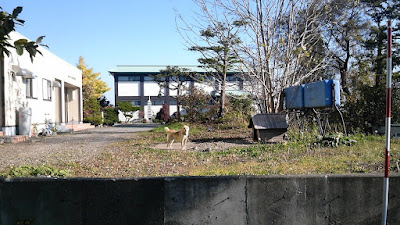
That last picture is of Temple Dog, who lives next to the lot where I park my car. He's called Temple Dog because he lives in a temple, and is a dog. I've never been accosted by demons of any sort near that parking lot so I think Temple Dog is doing a good job.

Monday, November 29, 2010

Thanksgiving: The Fattening

Being an American is similar in many important ways to having herpes. Among the myriad similarities is the fact that once infected, you're a carrier for life. It was in this spirit that I decided a good thing to do would be to invite an improbably large group of friends to my apartment and to cook two Thanksgiving turkeys, something I've never done before.

I'm still waiting for the pictures to come in but my kitchen looks like this right now:


Here's a picture of some food that I stole from Justin:


And we looked like this:


Look at all those foreigners crammed into my apartment! Who needs fire codes, anyhow. Despite a harrowing all-day journey, everything turned out well and everyone was made comfortably bloated. After eating, we all headed out for a night of dancing and karaoke, which I'm not really looking forward to seeing pictures of (although I'm sure I will). God bless!

Thursday, November 18, 2010

Good luck 2011 applicants!

Yesterday was the deadline for US applicants to submit their initial applications for the JET Program for 2011. I just wanted to post a short update and say, good luck! My best advice now is to find something to keep yourself busy, and to apply for other things and make plans for if you don't get in - the JET application takes forever, and it really helps to pass the time. And the unfortunate reality is that many otherwise qualified applicants won't get in, simply because there aren't enough spaces for everyone CLAIR would be willing to hire. So don't put all your eggs in one basket!

Nevertheless, I hope this blog has been a help to applicants and that I'll see some of you in August! Good luck everyone!

Saturday, November 13, 2010

Travels, Pt. I

This update will be something of a dumping ground for various pictures I have floating around from October. Chronology and relativity will be a bit strained, but hey, it's an update.


This is Asahidake, the highest mountain in Hokkaido, and the surrounding area. We traveled here for a friend's birthday and spent the day hiking and going up most of the mountain. At Asahidake, one rides a ropeway most of the way to the treeline, and then kicks around up at the top. Asahidake is an active volcano, and is full of vents belching sulfur. I'm still waiting for a bunch of pictures from this trip, because certain people are very slow at updating them. No names. This was in early October.


This is what's known as a ryoukan, a Japanese-style inn. The Monbetsu Crew traveled to Furano, Land of Lavender, for an ALT conference and we stayed here overnight. Ryoukans are meant to be fairly old-fashioned, and more involved than a standard hotel stay. You get a single tatami (rice straw mat) room like this one, with fold-out futons for sleeping on. They are actually wonderfully comfortable. With the normal stay, you get dinner and breakfast at the inn, and have a good soak in the tub before bed. More like a traditional resort than a hotel, ryoukans are popular in secluded areas but can also be found in cities, like Furano.


Nothing terribly exciting. Waiting for the bus to go home from a small town on the outskirts of Asahikawa, after a long weekend.

Finally, a special preview of my upcoming Halloween update:


Buddhist pilgrim. The effect is better when I have my staff, but it will have to wait.

Thursday, November 4, 2010

On The Road in Hokkaido

Sorry for the complete lack of updates in October! I've been quite busy, and I'm still waiting for some pictures from other peoples' cameras. Over the next week or so I'll try to get through a backlog of updates I meant to post, but didn't get a chance to. October was busy!

Today's update is actually from this week. At long last, I've got a car! I present the Daihatsu Opti, on a rare clear day:


I picked up this bad girl two days ago for a great price, and it's been quite fun tooling around in. The universal comment I get is "It's so cute!" Look at the size of those little wheels! In Japan, cars are classified as "Light" (yellow plate) and "Regular" (white plate) vehicles. The classification is mostly based on engine displacement, along with a few other restrictions. Light cars, like mine, have several fees lowered and bureaucratic hoops removed to encourage people to drive them. This is great! The downside is that they are clown cars. I can fit in just fine, and I can fit one other person of not-exceptional height, but anybody in the back seat is going to have to get comfortable with new methods of folding themselves. They can consider it a cultural experience.

I'll be taking her out for out first road trip this weekend, to go volunteer at a kids haunted house a few hours away. I will try to get pictures, as well as post later about the Halloween experiences I've already had in the last week or so.

As for the weather, it's been getting quite cold, in addition to a pretty dismal amount of rain. We had some snow a while back, but nothing that stuck; further inland, however, there's a good deal of snow on the ground. Winter is on it's way!

Thursday, September 30, 2010

A Week in the Life

As application season is upon us, and I have some time on my hands, I thought I'd write up a post about what a typical work at week looks like for me. I'll be doing a writeup of my week, as it's a pretty average one and gives a good idea of what I generally do for work. As always, potential applicants should remember that lovable JET mantra - Every Situation is Different! My situation, specifically, is teaching at seven different elementary schools. Here's how it plays out:

Monday

On Monday I went to Persimmon Elementary School (names change to protect the innocent). Persimmon is one of the largest elementary schools in town, with several hundred students. This was my second visit; on average, I visit about twice a month.

Since Persimmon is a larger school, I teach only fifth and sixth year students. English is more commonly taught in this age bracket than to younger students, and beginning next year these students will have a mandatory period of English study - something like 20 hours per semester.

My first period at Persimmon is free, and I spend it in the teacher's room preparing and drinking a really amazing amount of green tea. Second period I teach one of the 5th grade classes. Normally, in my first visit to a class I give a self-introduction and ask the kids to introduce themselves to me in simple English - name, something they like, things like that depending on the level of the class. On my first visit to this school, however, the fifth graders spent the entire time asking questions. Because of this, the class today consists of practicing self-introduction vocabulary and then delivering the self-introductions. It's a large class, so this takes most of the period.

Third period is the second group of fifth years. They ran out of time in their first lesson as well, as we do the same thing as the first group - self introductions. I wad up a piece of paper and pass it to a student, and have them introduce themselves. After they are done, they can toss it to a classmate and then sit down, and in this way it becomes more interesting for them than just going down the rows.

Fourth period is the first group of 6th years. The 6th years are significantly more reserved than the 5th years, and so we had plenty of time to do their introductions last class. Today's lesson, then, is going over the standard Daily Practice that I conduct whenever a class starts. This consists of greetings ("Hello class! Hello Tony!") and a few standard questions - How are you? How's the weather? What day is it? This gets the kids ready for English period, and was inherited from the previous teacher. Since I'm the first ALT at Persimmon, though, this needs to be learned anew. We spend the class going over the question "How are you?" and its various responses, and playing games to reinforce the vocabulary - the hot-potato idea from the fifth years worked well, so I do it again to make the students ask and answer the target vocabulary.

After fourth period is lunch. In Japanese elementary schools, lunch is carted into the classroom and the students serve each other and eat at their desks. I eat the kids' lunch with them, changing classrooms each time. Today is with the fifth years. Another quirk of Japanese school lunch is that it is generally accompanied by music - the Austin Powers theme today, for example.

After lunch is a free period, in which the kids mostly run around screaming. I go outside and play soccer with the students, which is a bit confusing because they manage to have four distinct games going on a single field. This results in quite a few eight year olds getting whacked in the back of the head, but they don't seem phased. The students expect me to be a natural star at any sport, and luckily I have a good ten inches at least on them so I don't usually let them down too badly.

Fifth period is the other group of sixth years, covering the same material as the first group. I have one more free period after this, and then the kids go home. I meet with the teachers and we plan our next lesson, and I go home.

Tuesday

Every Tuesday I go to Starfruit Elementary, one of my two set schools. It is a small-ish school, the smallest of the "big" schools I visit - it has all six grades, but some classes as small as four students. At Starfruit, I teach every grade - which classes I will do in a given day depends on the day. This week, I'm teaching the First, Second, and Third-year students.

My first three periods are free. I write, prepare materials, and drink a lot of green tea. Fourth period I start in on the first-years. This is the only school where I work with kids this young, which is a bit intimidating, but the key to the really young kids is just to have a lot of energy. This is my second time working with them. Our lesson for the day is introducing vegetable vocabulary. I first go through the flashcards, covering them with my hand and then slowly revealing the picture so the kids can guess what the item is - these are farm kids so they actually are familiar with things like cucumbers and kale. As we uncover each card we repeat it several times and then stick it up on the board. Once the cards are all revealed and drilled, we put them on the floor and the kids play karuta. Karuta consists of kids sitting in a circle with cards in the middle. The teacher says a word, and the first kid to slap the right card gets to keep it. This is a great standby game that can be applied to anything, and the kids are always excited to play it. We do this a few times and then the cards go back up on the board. Now I have the kids close their eyes, and then take away a card - the kids have to say which card is missing. This is a good activity because it gets the kids to actively say the words without prompting or repetition. They freak out when the game goes on and eventually more than half the cards are taken away. For the last time I hide the cards around the room and the kids run around trying to find them (hiding things from people that are two feet tall is really easy). The class is over and I have lunch - today is with the 4th years.

Fifth period I have the second years. The same rules apply as with the first years, for the most part - lots of energy. I meet with them more frequently than with the first years, so we continue an animal lesson from last week by introducing some new animals that live on a farm (again, most of these kids live on or near farms, so its pretty applicable to them). We play karuta with the cards, and then go over the sounds animals make - some of them are quite different from in Japanese (Pigs in Japan say buuu, buuu). Then we introduce the song Old MacDonald - a song the kids know in Japanese. We sing the first verse in English and the class is over. We'll continue next week with adding animals.

The last period of the day is third years. We've been doing family vocabulary, and last week the kids drew pictures of their families. We finish the pictures today and introduce them to the class - "This is my father, Hiroshi. This is my brother, Kenta," etc.. At the end we have some time left, so we talk about various animals we have at home - kids are always surprised to hear I have five dogs back in America. After class I plan out the next week's lesson with the relevant teachers, and head home.

Wednesday

Wednesday I head to Cantaloupe Elementary. Cantaloupe is my other regular school, and I go there every Wednesday. It's a larger school, like Persimmon, and like Persimmon I only teach fifth and sixth years here. First and second periods I have fifth years, and we finish up a month-long unit on actions - learning words like Run and Climb and grammar like I Like To and Do You Like To? The culmination of this lesson is a game in which kids get a sheet full of actions and have to walk around and ask each other if they like doing those actions - the goal is to find a yes for every action. Since Cantaloupe is a larger school, games that involve students interacting with each other work better than ones that are between teacher and student, as those activities tend to leave the rest of the class idle for a long time (you do not want to deal with bored ten year olds). This activity, and the preparation for it, takes the whole class period.

Third period is the first of the sixth grade classes. At Cantaloupe, the sixth year teachers give more guidance in class content, as compared with some other teachers at other schools. Today we continue a lesson from last week in which the students cut out cards for the alphabet and played karuta with them. The twist this week is that instead of just using letters, we use whole words, so the kids have to really practice listening to pronounciation. This lasts the whole period. Fourth period is free, and fifth is the other sixth year class.

Thursday

Today I drove out to Watercress Elementary. This is one of my smallest schools, lying in a small community about ten minutes out of Monbetsu proper. With only six students, lessons at Watercress have to take a different form, but I really enjoy going there. Its also one of the schools that I don't go to for an entire day - instead of showing up at 8:00, I go to the Board of Education until 10:00 and then drive out.

Watercress' students are divided into two classes - a class of three third years and one second year, and a class of three fifth years. The school was once larger, and included middle school students, but the population shrinkage in rural Japan has hit this community and it is now at its smallest size ever. Outside the school are the remains of the Watercress train station, which saw it's last train in 1985. Despite all this however, the school is well-funded and housed in a building just five years old. The students are also much closer than in the larger schools, seeming more like a family than like schoolmates. I visit Watercress around twice a month.

The teachers at Watercress plan the lessons beforehand, so I just have to follow my script. With the second and third years, we practice some set English phrases - look! Wake up! Good morning! I'm hungry! They show great enthusiasm for this. The fifth years are working on shopping activities, and today they take turns running a "shop" in the classroom and serving the other students. They learn vocabulary for various foods, and things like "One ____, please" and counting vocabulary for money. Last time I visited, we spent the fifth period after lunch picking beans from the school garden. They were delicious. Today I play "badminton" with the kids, in a variation that involves four players and no net. They are delighted with my attempts to use the racket like a sword (which does not work very well).

Friday

Tomorrow I am not scheduled to go to a school. The schools all hammer out their schedules at the beginning of the academic year, in April, and there are days when I don't have one to go to. On these days, I work at the Board of Education office, and generally make supplies and materials for future classes.

This has been really long, but hopefully informative for anyone interested in what an average day on JET is like. Again, this is just my experience - some people spend all their time at one school, some visit all levels of school, and some take different roles in the classroom.

Saturday, September 25, 2010

A Guided Tour of the Monbetsu Party Palace

As I am having friends over tonight for a delightful dinner, I actually cleaned my apartment. This is something of a first. I took this opportunity to take some pictures to share with those who haven't experienced the glory. If you are a prospective JET, this represents something like what you might end up with but as always, ~every situation is different~

My apartment is up on the fifth floor of a building owned by an elderly couple who also run a store downstairs. When you ascend the stairs the interior looks like this:


Charming! The interiors, however, are much more serviceable. You come in through the "genkan", a feature of Japanese homes where the floor is raised shortly after entering the house, leaving a small sunken area to take off your shoes in. From here you go straight ahead into the main living room area (click for larger pictures):


On the right you can see my bedroom (and prized vuvuzela), which is attached to the living room directly. You could hang a curtain if you wanted to. Another shot:


The blue pillows are the bed are zabuton, or Japanese butt pillows for sitting on the floor. I'm having company over so I have them out and ready to go. Also in the bedroom, you can see the traditional Japanese rice-straw tatami mats on the floor.

The kitchen is attached to the living room next to the entrance area. Here's a picture from the living room looking back towards the door:


To the left is the doorway area and the sunken genkan. Off to the left is the bathroom and toilet (different rooms!). There's also a washing machine visible in the kitchen. Additionally, although you can't see them, there's about eight different trash cans in there. The Japanese have a thing for trash sorting.

Hope you've enjoyed your tour of my apartment! Please come again when its covered in papers and clothing.

Monday, September 20, 2010

Kancho to the heart pt. 2

I have suffered my greatest personal disappointment thus far in Japan.

As you may be aware, karaoke is one of the factors that holds Japanese society, like a layer of duct tape on a high-powered engine valve (or something, I don`t know cars). Since JETs are masters of cultural adaptation, we tend to do our duty and adapt to the culture of karaoke with great enthusiasm. It was in this spirit that I went with friends to karaoke in Asahikawa this weekend. Far from a normal outing, however, this trip was special; I had recently been practicing a new song, with which I planned to blow everyone out of the water and most likely launch an multinational music career.

The song was Come Sail Away by the incomparable Styx. If you don`t know the song, look it up on Youtube and you`ll probably recognize it. It has all the elements I like in a karaoke song; namely, it`s extremely theatrical and dramatic, and the bulk of the vocals are well beyond my actual range. Needless to say, I was quite excited to have a chance to bust out my new song.

We got to the karaoke box, began queuing up songs, and I looked up my song and... nothing. They had Styx, but not Come Sail Away, so what`s the point? I was ruined. In despair I ended up doing Wolfmother - Woman, which turned out to be one of those songs I like in real life but which has two lines and a two-minute guitar solo. Not the best choice for karaoke.

Despite this terrible setback, I still managed to have a good long weekend (monday was Respect for the Aged day, a national holiday) full of shopping and food. I tried soup curry for the first time, which is sort of a Japanese vision of what Indian curry might look like. I also bought a vuvuzela, cementing my place in the world as a hipster three months past current.

This week is a short week, with Monday being a holiday and Thursday being another. On Friday, I`ll be playing ping-pong at one of my schools, something I`ve developed quite a taste for against all odds. Updates to follow.

Wednesday, September 15, 2010

Like a kancho to the heart

Long gap since my last post - I've been busy. Here's an update with some pictures, though!

Last weekend, myself and a slew of other JETs traveled north to attend to the Northern welcome party, in a town (village(intersection)) called Nakagawa. Nakagawa station, three hours into the mountains, looks like this:


We arrived Saturday afternoon and proceeded to dick around the town and set up camp before nightfall, at which point we hit the hot springs (pictures omitted) and commenced doing the sorts of things adults generally do while camping.

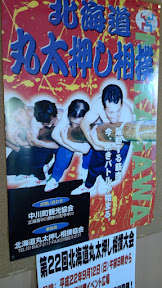
In the morning, several JETs had signed up for the local festival, which entailed many spirited rounds of log-pushing. Log-pushing is essentially a tug-of-war in reverse; teams hold on to each end of a large log, and attempt to push the other team out of the playing area. I didn't get to take any pictures of it, but this poster sums it up:


Hooray! One of the JET mens teams managed to make it to the semifinals, which was probably due to their fetching lumberjack costumes.

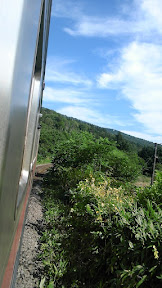
Here's some other random pictures from the train ride back and the night in Asahikawa before heading back to work:


In other news, I had my first experience with "kancho" today. For the blessedly unversed, kancho is an important part of childhood in Japan and is enjoyed by boys and girls of all ages. It consists of clasping the hands together with the index fingers outstretched, and then attempting to ram the resulting projectile as far up the rectum of any given adult as you can. Yeah, I don't get it either. I knew about kancho previously, but today was my first time having a kid actually go for it. It's not a one-time thing, either - this kid was really earnestly dedicated and it's quite hard to keep an eye on a specific 8 year old when you are surrounded by thirty of them.

Ah, Japan.